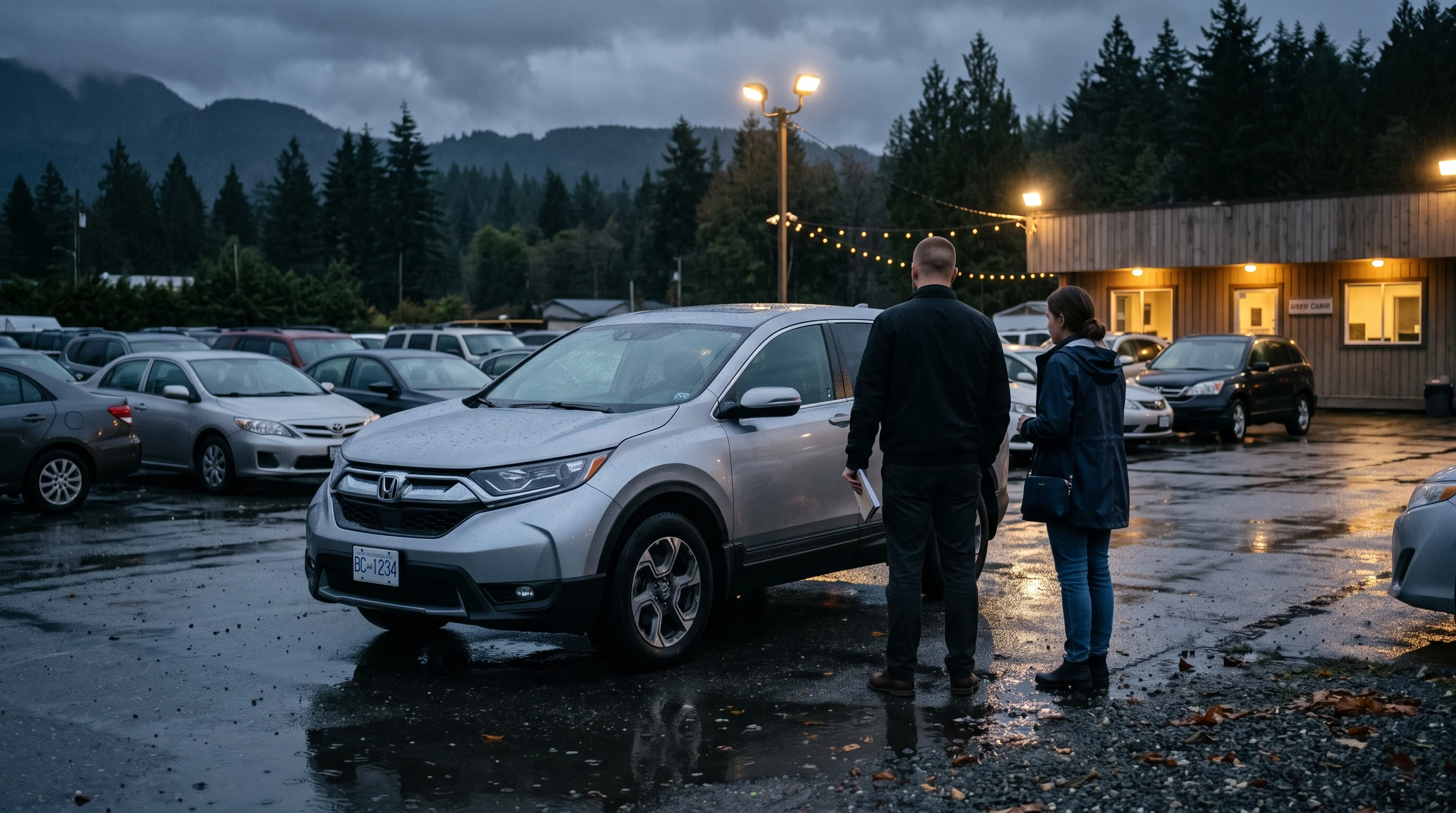
How Canadian dealers calculate trade-in value
When you ask a dealer what they'll give you for your car, they reference wholesale valuation guides like Canadian Black Book, check recent auction results for similar vehicles, and assess your car's condition, mileage, and service history. The number they offer is what they can afford to pay and still make a profit when they resell it — either on their own lot after reconditioning, or by sending it to auction.
The dealer's offer factors in reconditioning costs (detailing, minor repairs, safety certification), their overhead (lot rent, staff, insurance), and the risk that your vehicle sits unsold for weeks or doesn't command the price they expect. If your car needs tires, brakes, or has cosmetic damage, the dealer subtracts those costs from the offer. The result is a wholesale figure: the price the dealer pays to acquire inventory, not the retail price they'll ask when they resell.
In BC, trade-ins also affect the PST you pay on the vehicle you're buying. The trade-in value reduces your taxable purchase amount, which saves you PST on that reduction (typically 7-12% depending on the vehicle's price band). That tax offset is a real benefit, but it doesn't fully close the private-sale gap for most people.
Why trade-in value is lower than private-sale price
Private buyers pay retail prices because they're getting a finished, ready-to-drive vehicle and comparing it to other listings. When you sell privately, you're competing with dealer lots and other private sellers, and buyers expect a price that reflects the market for driveable cars. Dealers, on the other hand, are buying wholesale — they know they'll invest time and money getting your car ready for resale, and they need margin to cover that work and still profit.
A simple example: a 2018 Toyota Camry with 90,000 km might list privately for $18,000-$20,000. A dealer offers you $14,000 on trade. The dealer will spend $800-$1,500 reconditioning it (detail, oil change, brakes, safety), list it at $21,000-$22,000, and hope to sell it for $20,000 after negotiation. The gap between the $14,000 trade-in offer and your $18,000 private-sale expectation is the dealer's cost of doing business plus profit.
The gap widens for older, high-mileage, or less-desirable vehicles. Dealers can't retail everything profitably, so they lowball cars they'll auction off immediately. That's when trade-in offers feel insultingly low — because the dealer isn't planning to resell it themselves; they're flipping it to wholesale auction at near-cost.
When trade-in makes sense despite the lower value
Trading in is convenient. You hand over the keys, sign the transfer, and drive away in your new vehicle. No listing ads, no tire-kickers calling at 9 PM, no test drives with strangers, no payment-scam risk, no hassle. For busy people, or those who find private sales stressful, that convenience is worth paying for — even if the cost is $2,000-$5,000 in lost sale value.
Trade-ins also offer a PST benefit in BC. When you trade a car valued at $10,000 toward a $30,000 purchase, you pay PST on $20,000 instead of $30,000, saving you 7-10% PST on the trade-in amount (depending on the price band). That's $700-$1,000 saved in tax, which narrows the private-sale gap slightly. If the dealer's trade offer is only $1,500 below what you'd clear privately after effort and risk, the tax savings and convenience can tip the balance.
Finally, if your vehicle is hard to sell privately — older, high mileage, cosmetic or mechanical issues, niche model with limited demand — a trade-in guarantees you get something for it immediately, whereas a private sale might take weeks or force you to drop the price repeatedly. In those cases, the dealer's wholesale offer may be the realistic market value, and holding out for a private buyer costs you time with no better outcome.
When private sale wins: doing the math
If the gap between trade-in and private-sale asking price is more than $3,000-$4,000, selling privately almost always makes financial sense unless your time is exceptionally valuable or you can't handle the selling process. Even accounting for the PST benefit of a trade-in, a $4,000 gap means $3,000+ in your pocket after tax savings, which is material money for most Canadians.
Private sales take effort. You'll need good photos, honest ad copy, patience fielding lowball offers and no-shows, a safe public meeting spot for test drives, and a secure payment method (certified cheque or e-transfer from a verified account). You'll also need to handle the bill of sale and transfer paperwork. But the process is well-trodden: thousands of BC residents sell privately every month without incident, and the reward is keeping the retail value of your vehicle rather than handing it to the dealer as profit.
Before committing to a trade-in, get a realistic sense of what your car would sell for privately by checking current AutoTrader and Facebook Marketplace listings for the same year, make, model, and mileage. If comparable vehicles are listed $5,000-$6,000 above the dealer's trade offer, that's your decision point: is $3,000-$4,000 net (after effort and tax offset) worth the work? For many people, yes. For others, the convenience premium is worth paying.
How to maximize a trade-in offer if you're set on trading
Get multiple dealer quotes. Trade-in offers vary by hundreds or thousands of dollars between dealers, especially if one specializes in your vehicle's make or has buyer demand for it. Don't accept the first offer without shopping it.
Clean and detail your car before the appraisal. First impressions matter. A clean interior, fresh wash, and no trash or pet hair can nudge the offer $200-$500 higher because it signals the car was cared for and needs less reconditioning.
Bring service records. Documented oil changes, recent tire/brake work, and maintenance logs show the dealer your car was maintained and reduce perceived risk. That can translate to a higher offer or less pushback on condition deductions.
Negotiate the trade-in separately from the new vehicle's price. Dealers mix the numbers to obscure where margin is coming from. Lock in the new vehicle's price first, then negotiate the trade-in value in isolation so you can compare it to private-sale comps fairly.
If the offer is still far below market, consider selling privately even if it means a week of effort. The financial return per hour of work on a private sale often beats your hourly wage.
FAQs
What is trade-in value in Canada?
Trade-in value is the amount a dealer will credit toward your next vehicle purchase when you sell them your current car. It's based on wholesale pricing — what the dealer can pay and still profit after reconditioning and resale — so it's lower than private-sale asking prices.
How much less is a trade-in than private sale?
Typically 15-30% less, depending on the vehicle's age, condition, and demand. On a $20,000 private-sale vehicle, expect trade-in offers around $14,000-$17,000. The gap is wider for older, high-mileage, or niche vehicles.
Does trading in save PST in BC?
Yes. In BC, when you trade a vehicle, you pay PST only on the difference between the new vehicle's price and the trade-in value. That saves you 7-12% PST on the trade-in amount, which narrows the gap between trade-in and private sale by $700-$1,500 for most trades.
Is it worth selling privately instead of trading in?
If the gap between trade-in and private-sale price is more than $3,000-$4,000 after accounting for PST savings, selling privately usually makes financial sense. It requires effort (ads, test drives, paperwork), but you keep the retail value instead of handing it to the dealer as margin.
How do I know what my car is worth privately?
Search current AutoTrader and Facebook Marketplace listings for the same year, make, model, and mileage in your region. Filter by private sellers. The asking prices you see are your competition — expect final sale prices 5-15% below those asks after negotiation. You can also use a free market estimate tool to see current comp data.
When does a trade-in make more sense than private sale?
When the gap is small (under $2,000-$3,000 after PST offset), when your vehicle is hard to sell privately (very old, high mileage, cosmetic issues), or when the convenience of an instant, no-hassle transaction is worth the lower payout. The trade-off is personal: time and peace of mind vs. money.
Informational only, not financial or legal advice. Trade-in and private-sale outcomes depend on vehicle condition, market timing, and negotiation. Tax rules can change; confirm current BC PST treatment of trade-ins at gov.bc.ca.