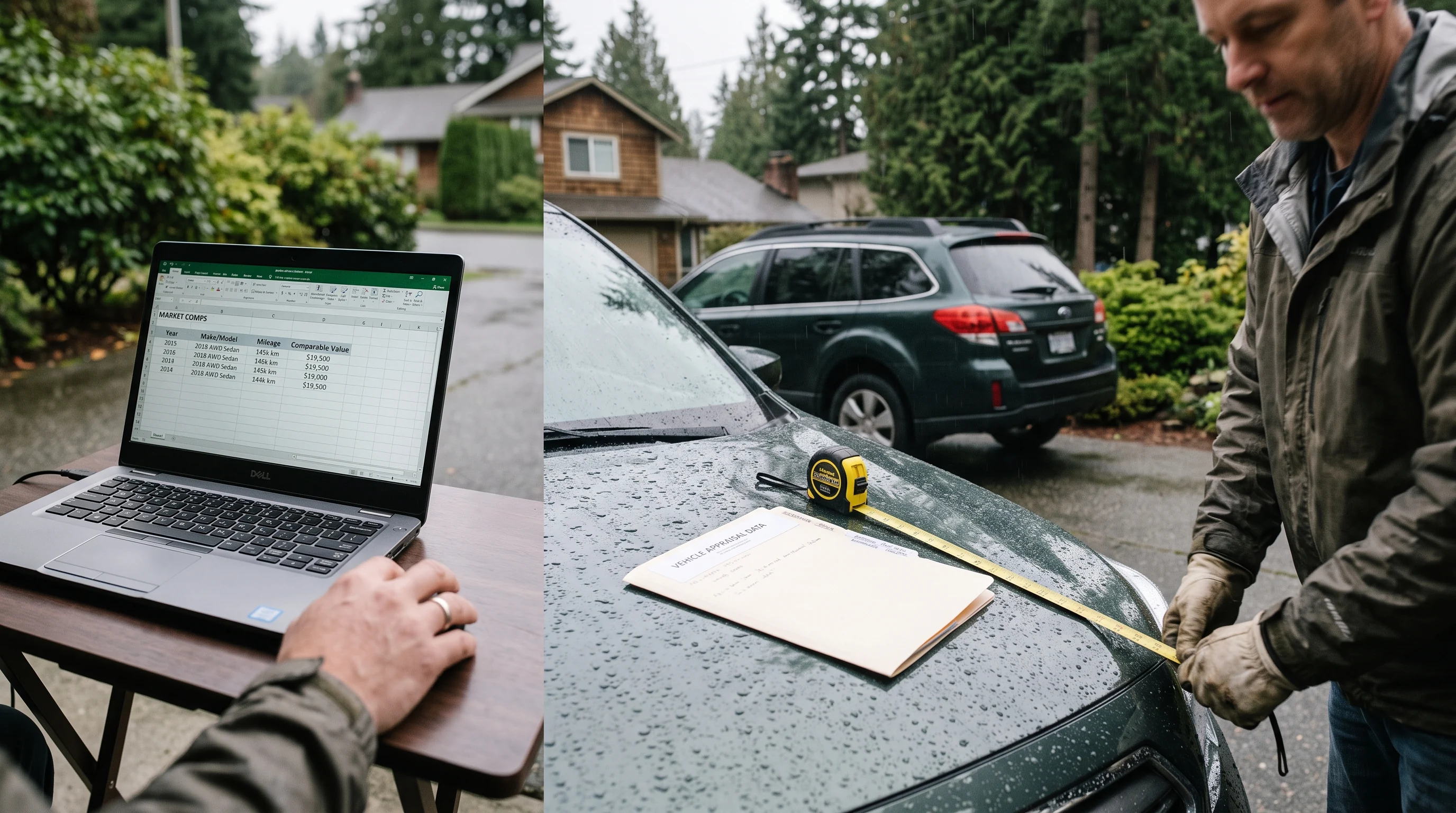
What a free estimate actually is
A free vehicle estimate is a market comparison tool. It searches current listings on platforms like AutoTrader for vehicles matching your year, make, model, trim, and mileage, then returns a range of asking prices (low, mid, high) from private sellers and dealers. The estimate tells you what similar vehicles are listed for right now, in your region. It does not inspect your specific car, doesn't account for condition beyond what you enter, and isn't signed by anyone with professional credentials.
Estimates are useful for pricing your own private sale, deciding whether a dealer's trade-in offer is reasonable, or understanding whether an ICBC total-loss offer is in the ballpark. They're research tools — fast, free, and directionally accurate — but they carry no legal weight. You can't submit a free online estimate to a tax authority, a court, or an insurance adjuster and expect it to substitute for a real appraisal.
Think of an estimate like checking Zillow for home values. It gives you a sense of the market, but no bank or tax assessor will accept a Zillow number as proof of what your house is worth. The same logic applies to vehicle estimates vs. formal appraisals.
What a formal appraisal is
A formal vehicle appraisal is a documented valuation performed by a qualified appraiser who physically inspects the vehicle, records its condition, mileage, service history, options, and any damage or modifications, and assigns a defensible fair market value. The appraiser signs the report, and in BC, certain appraisals must be completed on government forms like the FIN-320 Motor Vehicle Appraisal for the result to be accepted by authorities.
Formal appraisals cost money — typically $100-$300+ depending on the appraiser, vehicle type, and purpose. The fee reflects the appraiser's time, expertise, liability, and the documentation work required to produce a report that meets legal and regulatory standards. Where an estimate takes 30 seconds online, an appraisal requires an in-person inspection, comps research, and a written report.
The value of a formal appraisal is its legal standing. When you need to prove a vehicle's value to ICBC, BC's tax system, a court, or a lender, only a signed appraisal from a qualified professional will be accepted. A free estimate, even if accurate, has no evidentiary weight.
When a free estimate is enough
Use a free estimate when you're pricing a private sale and want to know what comparable vehicles are asking. You don't need an appraisal to list your car on AutoTrader — you need current market data so your asking price is competitive. An estimate gives you that in seconds.
Use an estimate to evaluate a dealer's trade-in offer. If the dealer offers $12,000 and the estimate shows similar vehicles listing privately for $16,000-$18,000, you know the gap and can decide whether to trade or sell privately. Again, no formal appraisal needed — this is a personal financial decision, not a legal requirement.
Use an estimate when you're curious what your car is worth but have no immediate transaction or dispute. Research, budget planning, or just knowing your vehicle's ballpark value are all appropriate uses for a free comp check. No paperwork required.
When BC requires a formal appraisal
BC specifically requires a FIN-320 Motor Vehicle Appraisal form when you're buying or importing a vehicle and want to pay PST on the vehicle's actual value instead of the higher Canadian Black Book figure. If the book value is $12,000 but your car is genuinely worth $8,000 due to high mileage or damage, a FIN-320 appraisal documents that lower value so ICBC assesses PST on $8,000. A free estimate cannot do this — only a completed FIN-320 signed by a qualified appraiser is accepted.
ICBC may require an appraisal when disputing a total-loss valuation. While you can support your case with comparable listings (which function like estimates), a formal written appraisal from an independent third party carries more weight in arbitration or negotiation. ICBC doesn't accept casual online estimates as evidence; they want a signed, defensible document.
Estate settlements, legal disputes, financing decisions, and import/export cases often require a formal appraisal because the value determines legal obligations, tax liabilities, or settlements. Courts, CRA, and financial institutions won't accept a free estimate from a website — they need a professional appraisal with a signature and methodology.
Classic, collector, or modified vehicles almost always require formal appraisals for insurance, financing, or sale documentation because their value isn't captured by standard market comps. A free estimate tool that searches AutoTrader won't find comparable listings for a 1972 Porsche 911 or a heavily modified off-road truck; only a specialist appraiser can value those vehicles properly.
How to choose: start with an estimate, upgrade when needed
The smart approach is to start with a free estimate. Get the market comp data, see where your vehicle sits, and determine whether you have a gap worth documenting. If you're selling privately and the estimate shows you're priced competitively, stop there — no appraisal needed. If you're facing a tax bill that's $1,500 higher than it should be because your car is rougher than the Black Book average, then the cost of a FIN-320 appraisal ($150-$250) is justified because it saves you $1,500 in PST.
Don't pay for an appraisal 'just in case.' Appraisals cost money and have specific use cases. If you don't have a legal, tax, insurance, or dispute reason to need a formal appraisal, a free estimate is all you need. But when you do need an appraisal, don't try to substitute a free estimate — it won't be accepted, and you'll waste time and potentially money.
The line is clear: estimates are for personal decisions and market research. Appraisals are for legal, regulatory, and financial evidence. Use the right tool for the job.
FAQs
What's the difference between a vehicle estimate and an appraisal?
An estimate is a free, automated market comparison based on current listings. It's for research only. An appraisal is a documented valuation by a qualified professional, usually after an in-person inspection, and it carries legal weight. BC tax authorities, ICBC, and courts accept appraisals, not estimates.
Can I use a free estimate for BC PST purposes?
No. If you want to pay PST on a lower value than the Black Book figure, you must provide a FIN-320 Motor Vehicle Appraisal form completed by a qualified appraiser. ICBC does not accept online estimates or casual valuations for tax reduction.
Can I use a free estimate to dispute an ICBC total-loss offer?
You can use comparable listings (which function like estimates) as supporting evidence, but a formal, independent appraisal is much stronger. ICBC will take a signed third-party appraisal seriously; they'll dismiss an online estimate as informal research.
When is a free estimate good enough?
For pricing a private sale, evaluating a trade-in offer, or general curiosity about your vehicle's market value. Anytime you're making a personal decision with no legal, tax, or official requirement, a free estimate is appropriate.
How much does a vehicle appraisal cost in BC?
Typically $100-$300+ depending on the appraiser, vehicle type, and purpose. FIN-320 appraisals for PST purposes are often $150-$250. Specialized appraisals for classic or modified vehicles can run higher. Free estimates cost nothing but have no legal standing.
Does the free estimate tool count as an official appraisal?
No. The free estimate tool on this site is a market comp research tool, not a licensed appraisal. It cannot be used for ICBC claims, BC PST reduction, estate valuations, legal proceedings, or any purpose requiring a certified appraisal. Use it for market research only.
Informational only, not tax or legal advice. This site's free estimate tool is a market comp research tool, not a licensed appraisal, and cannot be used for ICBC claims, PST, legal proceedings, or any purpose requiring a certified appraisal. Use it for market research only. Formal appraisal requirements can change; confirm current BC rules at gov.bc.ca.